
Today is the proudest day of my life.
I’ve never considered myself a particularly “unhealthy” person. However, as of early 2025 I rarely ever exercised and my weight continued to go up since basically the beginning of the pandemic, peaking at one point just over 230lbs and wishing I had a body I was proud of. While I do believe we should all love our bodies just as they are, I clearly wanted to make a change.
April 14th, 2025, was the day I stopped making excuses and locked in. I had the dream of making that before and after Instragram post one year later. And what a journey the last 365 days have been.
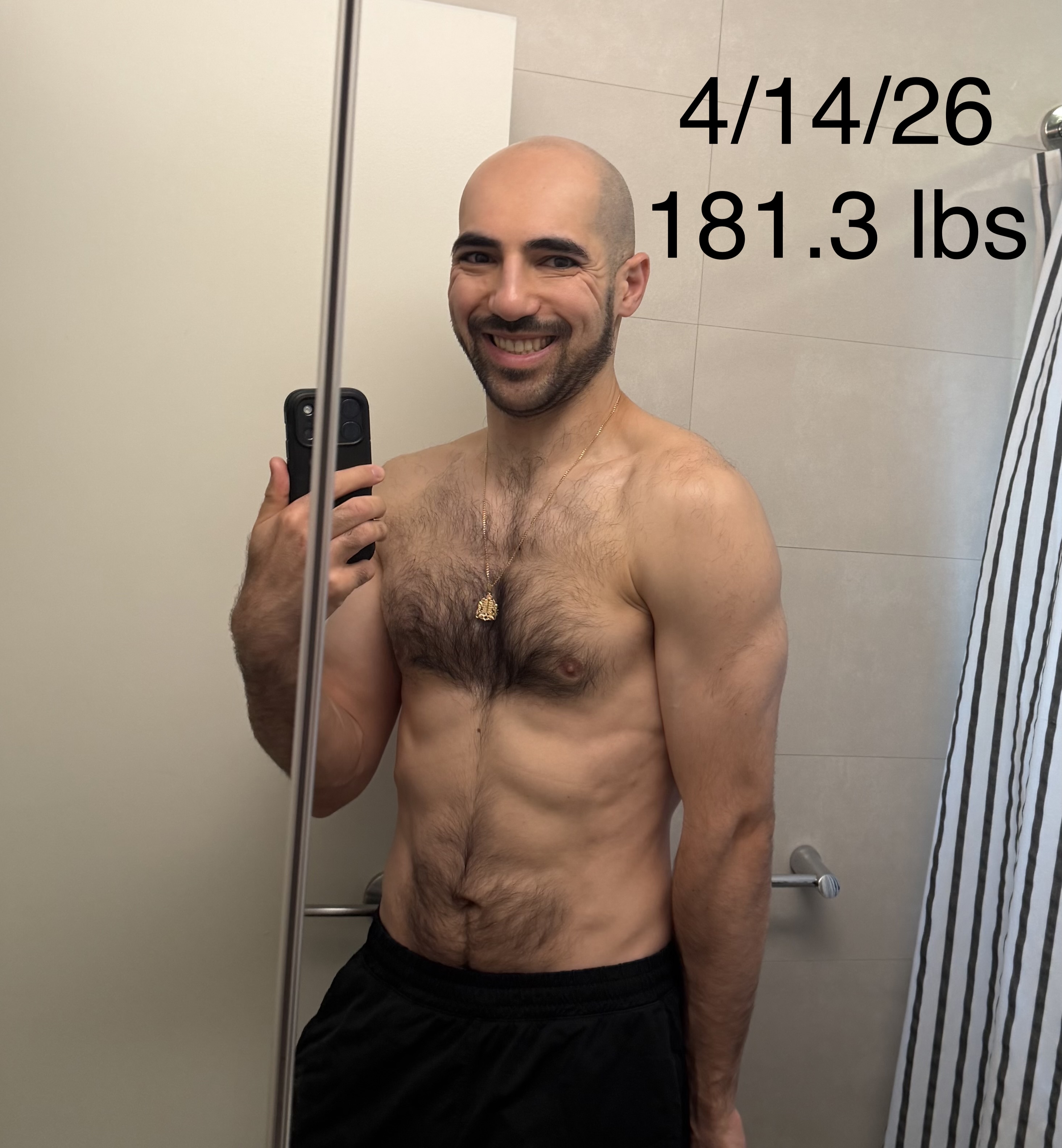
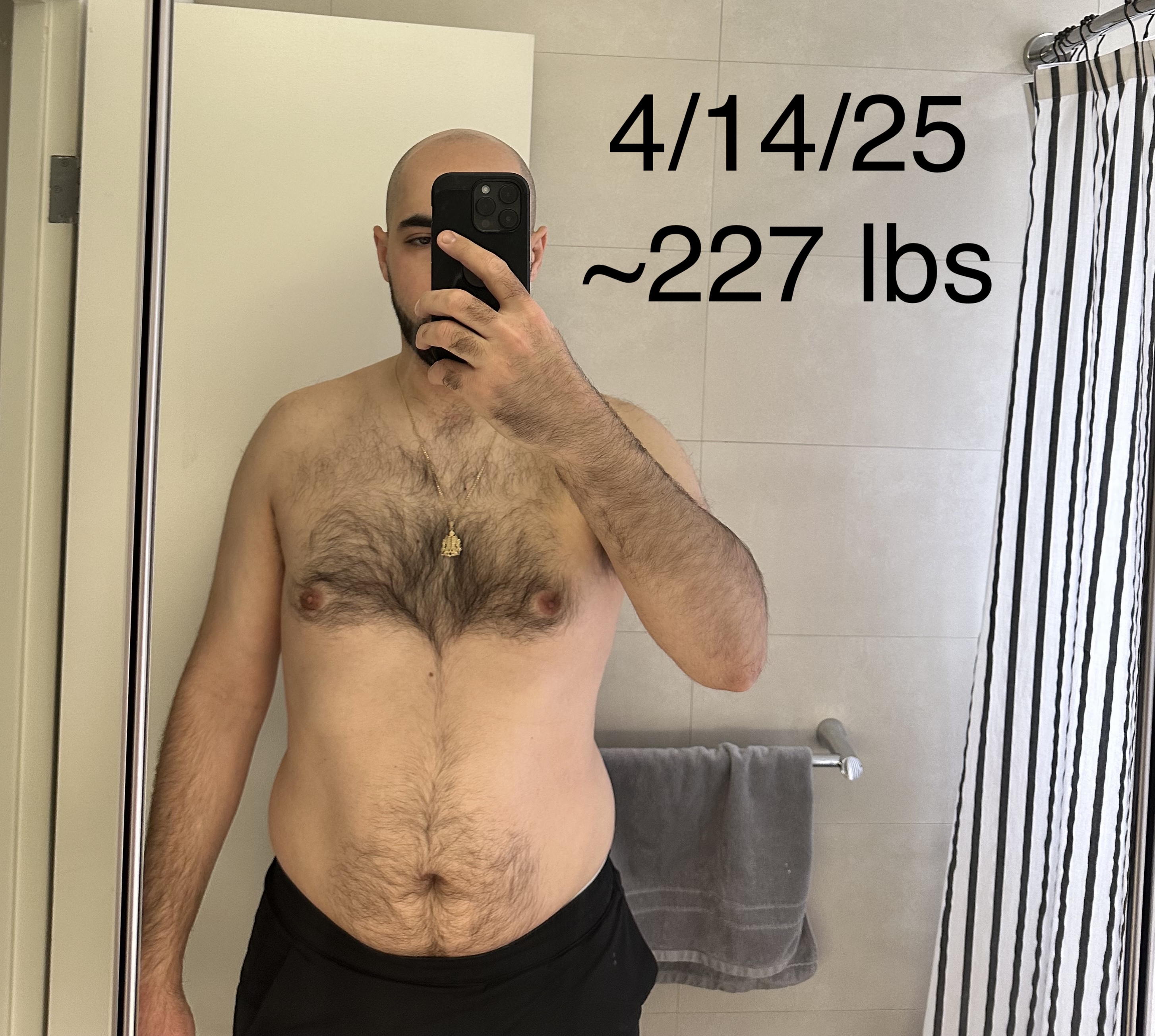
I want to share everything I learned in my journey to go from someone who rarely exercised to someone who regularly does 4 times a week and lost 45 lbs over the span of a year.
Some relevant background information:
- I am not a personal trainer or a registered dietitian. I am just a guy who has lost weight and gotten in shape. If you’re looking to do the same, I recommend talking to a doctor or a registered dietitian. They can help you create a plan that’s right for you.
- I am a 6’2”, 33 year old male.
- I eat a lacto-ovo vegetarian diet (no meat or fish, yes eggs and dairy).
- I work a desk job with a relatively flexible schedule, including a couple days a week from home.
- Prior to this journey, I had tried at multiple points in my life to consistently exercise, and nothing ever stuck for more than a month or so.
- I worked briefly with a trainer in early 2024. Some of the things I learned from that did help me get started.
If I wanted to achieve a body I always wanted, I knew I needed to dial in both fitness and nutrition. At around 227 lbs at the start, I didn’t exactly know how much I needed to lose, so I started out with a goal of getting down to 210. Once I got there, then it was to hit 200. Then 190. And now, I’m sitting here typing this at 182, with some of that being more muscle than when I started. Here’s how I did it, and I encourage you to to your own research as well.
Nutrition
I began my journey working with a registered dietitian. Boy did I not know what I did not know! My RD helped me better understand the relationship our body has with the various macro and micro nutrients While I did find diminishing returns after a couple of months, I do recommend anyone spend some time working with one if possible. Many companies (like mine) offer benefits.
The single, most important factor when it comes to weight loss is calories out > calories in. You can exclusively eat donuts and lose weight (though you will be malnourished, don’t do this). Conversely, if you’re trying to gain weight, the opposite is true.
Another key to embarking on this journey are sustainable lifestyle changes. What I found worked for me was initially calculating and counting calories. My RD helped me figure out what my “maintenance” calories are using a TDEE calculator, or Total Daily Energy Expenditure. Given I was committed to increasing my exercise and step count (more on that later), we calculated my maintenance was around 2900 calories. This is the amount of calories I would need to eat to maintain my weight if I stuck to my exercise goals.
Next, we calculated that if I wanted to lose about one pound a week. A pound of fat is approximately 3500 calories, so a “calorie deficit” of 500 calories a day would theoretically accomplish this. That meant, for me, a goal of 2400 calories.
We also calculated what my “macros” should look like. We calculated that I should land somewhere around 280g of carbs, 75g of fat, and 150g of protein. Now, there is currently a frenzy around protein: protein coffee, protein ice cream, protein pasta. Everyone wants more and more protein. The truth is, protein is extremely important, especially if the goal is to not just lose weight but also look “toned / muscular”, which was my goal. However, many fitness “experts” and “influencers” will suggest eating amounts as high as 1.5g per lb of bodyweight. At 230 lbs, there is absolutely no easy way to eat 345g of protein daily. Most people would get sick. From my own research, that number is also a very wrong recommendation.
The body can only utilize so much protein for optimal muscle growth, and that number appears somewhere around .73g/lb of lean body mass. That doesn’t mean less than that won’t build muscle, or that more than that is wasteful (excess is just converted to energy). But that’s a reasonable number to aim for. For most folks, shooting for somewhere around .7-.8g/1lb of their goal weight is probably good enough. If you want to get down to 150 lbs, aim for 120g protein per day (regardless of your starting weight). Extra protein isn’t bad, and protein is the most satiating macronutrient. I would also argue it is the most important one to “track”.
That being said, there is merit to eating more carbs and fats, as they are not the enemy! And truthfully, there are no good / bad foods. ANY food can be included as part of a nutrition plan. A good rule of thumb is to reserve 10% of your daily calories to eating whatever the hell you want. Ice cream, chips, whatever.
Carbs help fuel your daily activities and your exercise. Don’t cut them out entirely, though they are usually an easy place to “cut” from when you’re figuring out your diet plan. Fats too are necessary for hormone regulation and brain function. Your brain literally needs fat. However, I would argue fats are the easiest macronutrient to accidently over eat. Fiber is also extremely important for gut health. There is a global rise in colon cancer, and more fiber is one way to help prevent that. The guidance I’ve seen is to aim for 38g/25g daily for a male/female. Fiber also helps keep you full.
In terms of my own diet plan, what helped a lot for me was to save most of my calories for dinner, since this was the meal I had the most variance on given my day-to-day schedule. I generally ate the same breakfast and lunch every single day, and those two combined generally put me at just under 1300 calories and nearly 90g of protein. I usually had a bigger breakfast and then either a lower calorie yogurt bowl or protein smoothie for lunch. This way, in most cases, if I “overate” at dinner it just meant I likely ate at maintenance for the day. I do have an active social life and love going out to dinner with friends, so I did aim for a slightly lower calorie count during days I was entirely cooking (I was given the green light that as low as 2100 was “ok”) so I did strive to stay between 2100 and 2300 to give myself a little more breathing room for the social activities. This ended up working well for me.
BUT, I did change my strategy when I did eat out. Notably, I reduced my alcohol consumption significantly. From a health perspective, alcohol is terrible and very high in calories. In most scenarios where I may have had two drinks out, I instead had zero or one. Still, I had a few nights of overconsumption. None one of us are perfect. You’re going to have days where you screw up your diet. It happens. One bad day will not screw up weeks and months of progress. What is extremely important is that you just get back on the plan afterwards. Realize that if you eat 500 calories over maintenance one day and 500 calories under the next while back on your plan, you essentially just spent two days at maintenance. No big deal!!
If you don’t want to necessarily cut calories, here are a few easy suggestions that helped me:
- Buy a digital food scale!! They’re under $20 and make a WORLD of difference in knowing exactly how much food you’re eating. Minimize “eye-balling” portion sizes, you’d be surprised how easy it is to be way off.
- Cook with spray oils instead of pouring out of a bottle. Oil is sneakily high in calories. A tbsp of oil has 120 calories. Spraying a pan will usually be around 10 calories.
- Invest in an air frier. I love air-fried tofu and broccoli, and only lightly spray them with oil.
- Some foods, like pasta, have variants with protein. I personally love Brami Pasta. It’s made from lupini beans and has a ton of protein and fiber. I use it as a 1:1 substitute for regular pasta and it’s great!
- Prioritize whole foods. These are foods that are unprocessed and in their natural state. Think fruits, vegetables, lean meats, fish, eggs, nuts, seeds, and legumes.
- Cook whenever possible. On average, home-cooked meals are likely to be lower in calories than takeout.
- Focus on food “volume”. These are foods that are high volume and low calories. Think broccoli, egg whites, salads (with low calorie dressing)
- Reduce liquid calories. Regular soda, juices, alcohol, etc.
As for what I eat, here’s my current daily meal plan for weight loss. I’ll note, these protein numbers are higher than what I stated is necessary, but this is what I’ve found keeps me full:
- Preworkout: 1 banana. 100 calories, 2g protein
- Breakfast: 4 jumbo eggs, 1/4 cup shredded mexican blend cheese, two slices of Dave’s Killer Bread (the 21 whole grains and seeds kind), half of an avocado with a dash of Truff hot sauce. 725 calories, 48g protein Lunch: 300g of Fage 0% Greek Yogurt, 1 tbsp chia seeds, 15g sliced toasted almonds, 100g frozen berries, 1 tbsp honey, tons of cinnamon, 430 calories, 39g protein
- Dinner option 1: 1/2 block extra firm tofu (air fried with 1 tbsp corn starch, 1 tbsp soy sauce, 1 tbsp nutritional yeast), 1/4 cup jasmine rice, 1/4 cup quinoa, 6oz edamame, 12 oz air fried broccoli, 1/4 cup Whole Foods Teriyaki sauce. 1050 calories, 75g protein
- Dinner option 2: 6z Brami Pasta, 1/2 cup textured vegetable protein (mixed with smoked paprika, salt, pepper, italian seasoning, garlic powder, onion powder, and a little soy sauce), 1/2 jar Whole Foods marinara, two massive handfulls of spinach, 1/4 cup low fat mozzerella cheese. 1000 calories, 72g protein
- Dessert: I LOVE Yasso bars. The ones without chocolate shells are 80-100 calories and 5g protein.
Supplements
I take two supplements every day:
- 2000IU of Vitamain D3, as instructred by my doctor given a borderline deficiency (which many folks are)
- 10g of Creatine Monohydrate, as discussed with my RD. Creatine is one of the most researched supplements out there, and is proven to help with muscle growth, strength, and cognitive function. Creatine is naturally found in meat, but there are benefits to supplementation. The recommended daily intake is 3-5g, but I take 10g because I am a bigger guy and also do not consume meat.
I did use protein powder for a while and still have some on hand for days I think I’ll fall short of my protein targets, but have since replaced daily consumption with plain non-fat greek yogurt, which has a similar calorie / protein ratio. There’s nothing wrong with protein powder, but I personally enjoy the taste of greek yogurt more. Also, many protein powders (and yogurts, for that matter) have a lot of added sugar and other chemicals that aren’t necessarily the best for you. Remember, keep it simple. Naked Nutrition has some great powders (including vegan options) and I still use their creatine.
The best pre-workout in my opinion is a cup of black coffee, a glass of water, and a carb source such as a banana or rice cakes.
GLP-1s
GLP-1s are truly a game changer for weight loss. I personally know many people who have used them and seen unbelieveable results though I do not know enough to comment on the pros and cons. What I have seen is that they still require a ton of work and lifestyle changes to still be effective, and I commend anyone using any tools at their disposal with proper medical supervision to aid in their weight loss journey. For my own journey, I did not use them.
Vegetarian hacks
As a vegetarian, I’ve had to get a little creative with my protein sources at times. Here are some of my go-tos. In general, I aim for foods with roughly a 10:1 calorie to protein ratio or better.
- Protein pasta
- Edamame
- Tofu
- Textured vegetable protein (TVP)
- Seitan
- Tempeh
- Shredded cheeses
- Greek yogurt (plain non-fat is by far the best)
- Cottage cheese
- Eggs (I personally eat full eggs, but egg whites are a great low calorie option)
- Chia seeds (higher in fat and fiber than protein, but ridiculously healthy and still contain some)
- Protein powder
Weight lifting
One of my goals for this journey was to no longer be someone who spent their life “wanting” to workout. Rather, I wanted to be someone who “does” work out. And now I can proudly say I am that!
I really enjoy weight lifting. I enjoy getting stronger and tracking my progress over time. If I did nothing else productive in a given day but still made it to the gym, I would still consider that day a win.
Through my RD, I learned that muscle is metabolically active. So while strength and aesthetics are great, building muscle also increases your metabolism. The higher your metabolism, the more calories you burn at rest. How cool is that?! While this isn’t a massive difference (~6 calories per lb of muscle), it adds up over time.
After trying a ton of gym routines, the one that has stuck with me is a four-day upper / lower split. I’ve been really pleased with this and after a ton of research (and admittedly some tweaking with Gemini) I do the following:
Monday / Thursday:
- 15 degree incline barbell bench
- Pullups
- Dips
- Cable rows
- Cable lateral raises
- Preacher curls
- Tricep extension
- Cable flies
Tuesday / Friday:
- Back squats
- Romanian Deadlifts
- Leg extensions
- Leg curls
- Calf raises
- Cable crunches
Every exercise I do two sets at the same weight close to failure. I do the heavier compound lifts in the 5-8 rep range, and the rest in the 8-12 rep range. Basically, I stay at a weight until I can hit the top of the rep range on my first set, and then add 5 lbs the following week while reseting to the bottom of the rep range. This is what’s known as progressive overload, and it is the key to building muscle.
As a beginner lifter, the weight I could lift went up quickly! But this did eventually slow down after about 4-5 months, which is commonly known as “newbie gains”.
Some tips for beginners:
- Don’t live in the gym. 3-4 days is plenty (a three day routine could be three full-body days or flipping between lower and upper).
- Make sure you hit every muscle group at least twice a week.
- Don’t skip leg days!! Our biggest muscles are in our legs. Remember, more muscle = higher metabolism
- Do exercises you like! If you don’t like pullups, do lat pulldowns. Or do dumbbell press instead of bench press.
- Make sure you’re pushing close to failure. If your last few reps aren’t a clear struggle, you likely aren’t working hard enough to stimulate muscle growth.
- I recommend staying in the lower rep range with heavier weights. Tearing your muscles (the stimulus to actually repair / build new muscle) happens on those last few tough sets. Why take more time to get there?
- Track your lifts, and don’t change your routine too often. If you start a new one, try and stick with it for at least 8 weeks
- If you have no idea where to start, there are tons of free workout programs you can find online. Reddit’s r/Fitness has a great wiki with a ton of options.
- I also recommend Jeff Nippard, Jeremy Ethier, and Sean Nalewanyj as fantastic sources of fitness information. Jeremy’s three day full body routine is a great place to start as well.
Cardio
Cardio is really important for heart health. It’s a decent way to burn calories, but a terrible tool for offsetting a poor diet. You can burn 300 calories in 30 minutes on a treadmill, and you can eat 300 calories in 10 seconds.
I don’t enjoy cardio, but I did do about 30 minutes of incline walking on the treadmill 2-3 times a week. I also made sure to get 10k steps in every day. Living in midtown Manhattan, I fund this very easy to do, as I would allocate a little extra time to get places. A subway ride to my office takes about 20 minutes, or it’s a 30 minute walk. I find I rarely take public transportation anymore, unless the weather is especially poor or I’ve already got my steps in for the day.
Sleep
Sleep is extremely underrated. Poor sleep leads to poor food choices and poor workout performance. I notice a difference when I get ~6 hours versus 7+ hours. Prioritize high quality sleep. I use an Oura ring to track my “sleep score” and it helped me get into a better groove with going to sleep earlier and making sure quality is higher. Considering we spend 1/3 of our lives in bed, it’s worth investing in a good mattress, pillows, and sheets.
The scale
As someone who loves thinking in terms of numbers, I found the scale to be a helpful tool in my journey. I did weigh myself every single morning repeating the exact routine of waking up, going to the bathroom, and then weighing myself. An important thing to remember here is that weight can fluctuate day-to-day as the amount of water weight we carry can make the scale shift by a few lbs in either direction. This is especially true after a night of eating high sodium foods. No, your dinner didn’t cause you to gain two lbs overnight. This goes away in a couple of days.
For me, I gauged progress by the scale hitting new “lows”. This usually happened at least once or twice a week where I’d see some amount of downward movement. I also experienced periods where my weight would plateau for a week or two at a time and then all of a sudden my body weight would drop by 2-3 lbs as if seemingly overnight.
But keep in mind, the scale isn’t the whole story! Other ways to measure progress are how you feel, how your clothes are fitting, and if your lifts in the gym keep increasing. Some folks also choose to measure once a week, but I preferred daily to account for water weight fluctuations.
The timeline
You’ll notice I lost 45 lbs in 52 weeks, which is just under a pound a week. While this is a great rate of weight loss, this was not consistent. This was my timeline:
- From mid April - mid September, I went from 227 - 195.
- From mid September to late December, I paused the weight loss to give my body a chance to reset. Between a 3 week vacation to Southeast Asia and the holidays, I gave myself a bit of a diet break.
- From late December to April 1st, I went from 195 to 182.
- From April 1st to now, I’ve been successfully maintaining at 182 lbs.
From what I’ve read, once you get lean enough (I would say within 20 lbs of your goal weight), fat loss becomes harder and periodic maintenance breaks give your body’s hormones a chance to reset before another fat loss phase.
I’m a little obsessed
I will admit, I did become a bit obsessed with fitness over the last year. There were definitely some moments where I laughed at myself for some of the measures I took, but in the end everything did add up. Here are some notable highlights:
- Walking around Grand Central Terminal for an hour to get my steps in, and then walking the 40 minutes home from there.
- Bringing a food scale with me to work.
- Setting a goal to hit 11k daily steps in March (my 33rd birthday) to get 333,333 steps. I hit 365,102.
- I won a weight loss contest at my gym for the month of January
I also lived a wonderful life
That being said, overall I still lived an incredibly fullfilling life and ate a tremendous amount of delicious food along the way. The efforts I made at home and in my free time meant that I COULD go out and enjoy food with my friends. Fitness is not meant to be torture. Difficult? Sure. But the sustainable habits, such as giving myself some smart “cheat” meals when events came up such as weddings or dinners out with friends. I think I will follow this blog up with a future one that distills some of this down into easier-to-process steps for beginners.
What now?
Well, it’s been an amazing journey. With the knowledge I now have of exercising and diet, I’m confident I will likely never regress to being in the shape I was in when I started a year ago. I feel amazing, love the the body I’m in, I’ve dropped multiple clothing sizes, and I’m excited to continue seeing where this goes.
Despite having lost 45 lbs, I want to still lose a little more to really lean into that “shredded” look. We’ll see where I’m at after maybe cutting another 8 lbs. Then, I’ll probably just focus on maintaining my current weight over the summer, before switching into a “lean bulk” for the colder months (eating 300-500 calories above maintenance to build muscle).
What’s also incredibly interesting to me is what I was able to accomplish setting my mind to something. I have ideas for what other things non-fitness related I’d like to accomplish, and am looking forward to writing a blog on April 14th, 2027 with my next update.
If you are on your own fitness journey, please let me know if there’s anything I can do to help! Please message me on LinkedIn or Instagram. I’d love to hear about your journey and offer any advice I can.